I’ll miss mass market paperbacks

The article linked to below discusses the grim future of mass market paperbacks. Mass market paperbacks were an essential part of my early reading experiences. I started reading adult books when I was 10 with mass market paperbacks copies of Bruce Catton’s Civil War books. I remember having James Michener’s Hawaii with an insert of color photos of the then-current movie from 1966. I had Ian Fleming’s James Bond books and novels by John Steinbeck. I remember the mass market versions of George Orwell’s 1984 and Animal Farm.

As I got older, I could afford hardcover books. It’s been a while since I got a mass market paperback. Still, they were an important part of my life when I was young.
What a loss. Mass market paperbacks are the ideal novel format.

turner lobey (@turnerlobey.bsky.social) 2025-12-14T17:54:00.628Z

Thomas Pynchon’s “Low-lands”

I have been thinking about Thomas Pynchon a lot recently since his new novel will be released on Tuesday, October 7th,

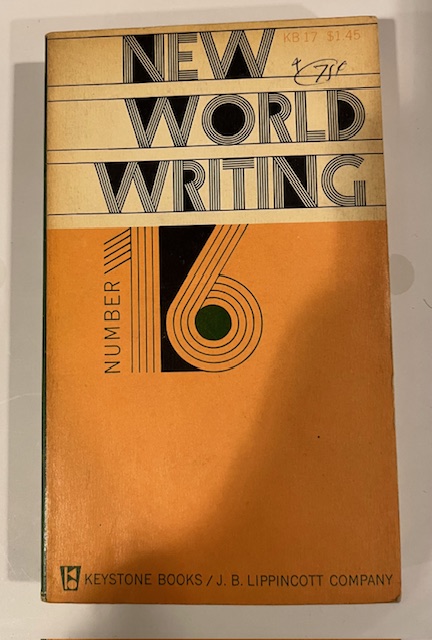
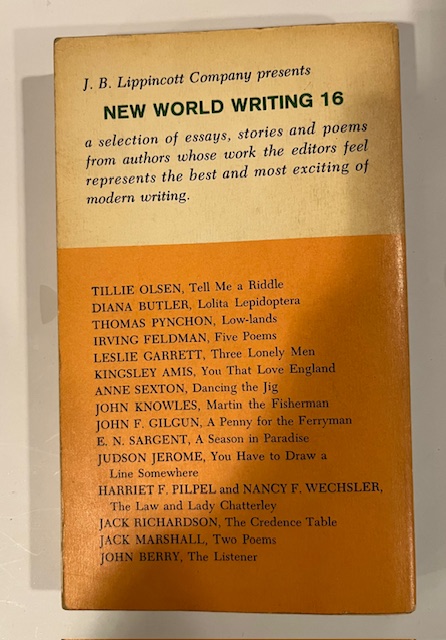
Here are the front and back covers of a literary magazine, New World Writing, from 1960 that included Pynchon’s “Low-lands”. The story was later included in his 1984 collection Slow Learner. The story includes the character Pig Bodine who also appears in Pynchon’s novels V. and Gravity’s Rainbow.

Videos of Thomas Boswell’s induction into the Baseball Hall of Fame

The great writer Thomas Boswell was inducted into the Baseball Hall of Fame this weekend.

Thomas Boswell’s speech in Cooperstown: ‘Thanks, baseball’ (Text of the speech)

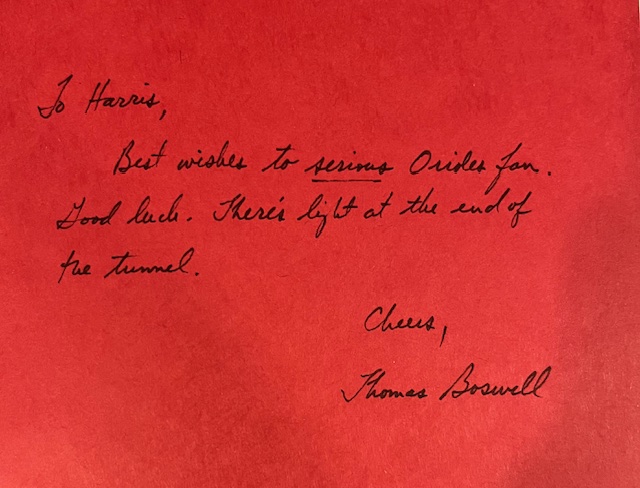
I saw Boswell speak and sign books at Politics and Prose in Washington in 1989 when his book The Heart of the Order was released. He asked people if they were Orioles or Senators fans and would write an appropriate inscription – see mine below.

As I recall a woman said the book was for her nephew, a New York Mets fan. Boswell said something like “What do you want me to say? Good luck to obnoxious, arrogant Mets?”

My first college newspaper book review

I wrote for the Pitt News during my junior and senior years (1973-1975). My first article was a review of Thomas McGuane’s NInety-Two in the Shade on September 21, 1973. My memories of the book are more positive than the review was and I recommend it and McGuane’s work in general.

I saw McGuane in person in a bookstore in Washington, DC in 1989 when he was signing his current book Keep the Change.

Here’s my recollection of our conversation as he signed Ninety-Two in the Shade:

Me: This was the first book I reviewed for my college paper.

McGuane: That makes me feel old.

Me: Me, too.

“The City That Reads” and my conversation with Elmore Leonard

Under Mayor Kurt Schmoke, Baltimore used the slogan “The City That Reads”. This would have been in the late 1980s and/or 1990s. When Baltimore was #1 in teen pregnancy at some point during this time, cynics called it “The City That Breeds”.

I don’t recall the year this happened but I went to Washington, DC to see Elmore Leonard at a bookstore and get books signed by him. I rushed there after work in Baltimore, it was hot and I was sweaty and I got there just before the event was over.

I explained this to him and we had a conversation that went something like this.

Me: I am sorry to be late but I came here from Baltimore

Leonard: Baltimore? We needed you there earlier today (They had a poorly attended book signing in Baltimore at a store – I was not aware of it.)

Me: They call it “The City That Reads”

Leonard: That must be a new slogan.

I saw him again a year or two later and gave him a “The City That Reads” bookmark.

The New York Times on Randy Newman

Randy Newman is one of the greatest American recording artists. If you don’t know his work, start with Sail Away, his 1972 album. I saw him live in 1971 with Bonnie Raitt as the opening act at Carnegie Mellon University in Pittsburgh, It was just Newman and his piano, similar to his 1971 live album.

I was glad to see him getting attention because of the new book about him

Author Robert Coover died on 10/5/24

I haven’t read much of the prolific Robert Coover’s books. I have very fond memories of two of his early works:

The Cat in the Hat for President from 1968 was originally published in the fourth issue of the New American Review. It’s about just what it sounds like it’s about – the Cat in the Hat runs for president. 1968 was one of those years that made anything seem possible.

The Universal Baseball Association, Inc., J. Henry Waugh, Prop. is about a guy who creates an early fantasy baseball league. It’s about baseball but also about larger issues like destiny.